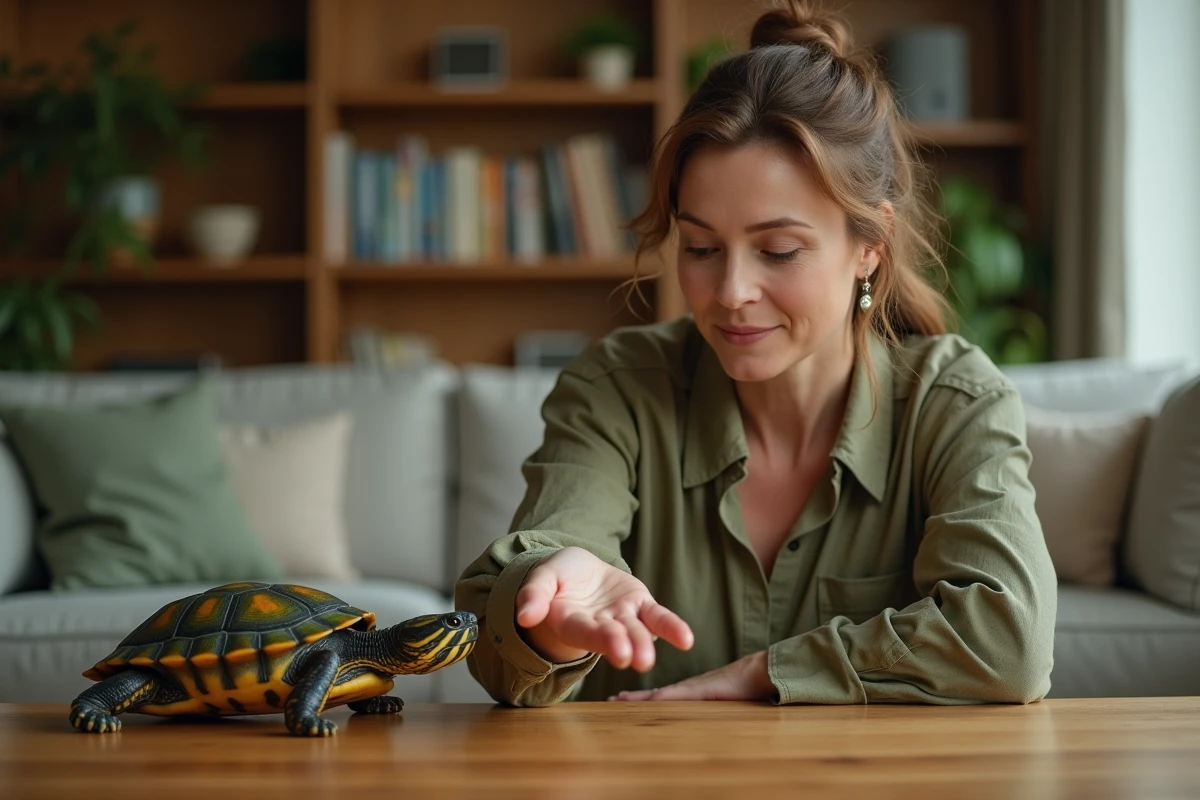
Turtles do not express their relationship with humans like a dog or a cat. Their nervous system, lacking a developed neocortex, does not produce attachment in the mammalian sense of the term. The question of whether a turtle recognizes its owner therefore relies on different cognitive mechanisms: visual memory, associative learning, and sensory discrimination.
Visual memory and social discrimination in turtles
The recognition of an individual by a turtle does not solely depend on food or smell. A meta-analysis from 2021 on reptile cognition (Szabo and Whiting, Biological Reviews) shows that several species of turtles learn to distinguish human individuals based on simple visual signals: shapes, colors, movements. These learnings are maintained over the long term.
In other words, when a tortoise turns its head towards you while ignoring another person in the room, this behavior has a measurable cognitive basis. The turtle has memorized your silhouette, your recurring gestures, perhaps the color of your usual clothing.
A 2020 study on captive freshwater turtles (Pseudemys nelsoni) (Mueller-Paul et al., Animal Cognition) goes further. These turtles were found to be capable of recognizing previously encountered conspecifics, adjusting their behavior based on past interactions, and retaining this social information for several weeks. The experiment focused on relationships between turtles, but it demonstrates the existence of a durable social memory, transferable to the relationship with a familiar human.
Many owners wonder if a turtle can recognize its owner or if it simply reacts to food. Recent scientific data indicates that the answer lies somewhere in between: the turtle does identify a specific person, but this identification remains linked to repeated associations (care, presence, feeding).
Signs of recognition in a terrestrial turtle: what to observe
The behavior of the turtle in the presence of its owner is the best indicator. Several signals regularly appear in field observations and testimonies from experienced keepers.
- The turtle comes out of its shelter or interrupts a resting phase when a specific person enters the room or garden, while remaining still in front of other visitors.
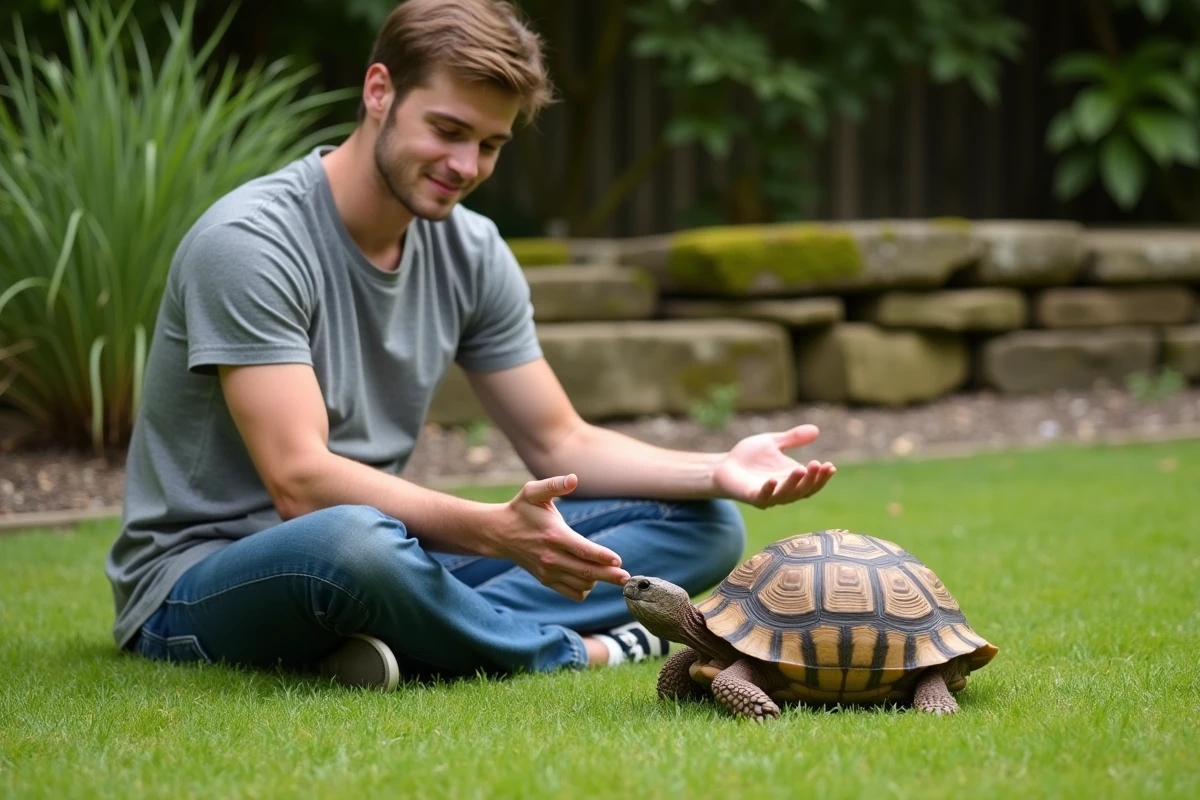
- It approaches spontaneously, stretches its neck towards the hand or face, sometimes giving light nudges, an exploratory behavior directed towards a familiar individual.
- It accepts physical contact (petting on the shell, touching the neck) from its owner while retracting from a stranger.
- Its level of activity and appetite increases in the presence of a person regularly associated with daily care.
A testimony on a forum dedicated to Sulcata illustrates this phenomenon well: after a year of absence, the owner notices that his seven-year-old turtle becomes more active, eats more, and systematically approaches him while avoiding other family members. This type of reaction goes beyond simple food conditioning, as other people fed the animal during the absence.
Trust and turtle-human relationship: building a bond without confusing it with affection
The word “attachment” poses a problem when applied to turtles. In mammals, attachment involves a hormonal system (oxytocin, cortisol) and brain structures that reptiles do not possess in the same form. What a turtle develops towards its owner is more of a trust relationship based on predictability.
A turtle living in a stable environment, with regular care routines, eventually associates the presence of a specific human with the absence of threat. This association produces behaviors that resemble affection: voluntary approach, tolerance to contact, seeking closeness.
What fosters trust
The consistency of interactions matters more than their intensity. Feeding the turtle at fixed times, speaking to it with a constant tone, avoiding sudden movements: these elements gradually build a lasting positive conditioning. Terrestrial turtles like Hermann’s or Sulcata, which live for several decades, accumulate associations over many years.
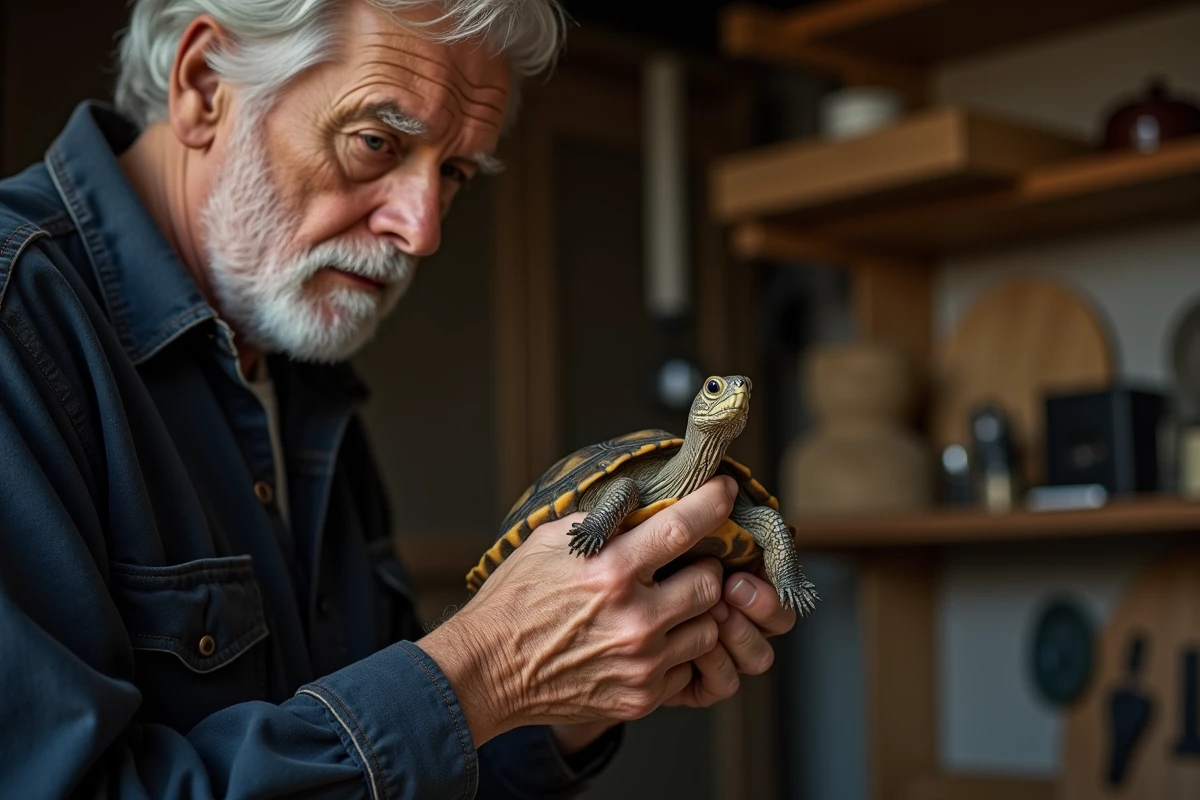
Excessive handling produces the opposite effect. Turtles do not appreciate being lifted: the loss of contact with the ground triggers measurable stress. An owner who respects this limit will be better “recognized” than another who frequently handles the animal.
Associative learning and limits of conditioning in reptiles
The cognition of turtles largely relies on associative learning: a stimulus (your silhouette, the sound of your footsteps) is linked to a consequence (food, absence of danger). This mechanism is robust and well-documented in reptiles.
Its limits are equally real. A turtle likely does not experience emotional absence in the way a dog would. The increase in activity observed upon the return of an absent owner reflects a reactivation of positive associations, not an emotion of reunion comparable to that of a social mammal.
This distinction does not diminish the value of the relationship. It correctly situates it: the turtle recognizes, memorizes, and adjusts its behavior towards a familiar human. It is a form of authentic bond, built on cognitive abilities specific to reptiles.
Owners looking for signs of attachment in their turtle benefit from observing differential behaviors (different reactions depending on the person present) rather than interpreting each approach as affection. A turtle that distinguishes you from a stranger is already granting you something remarkable for a reptile.