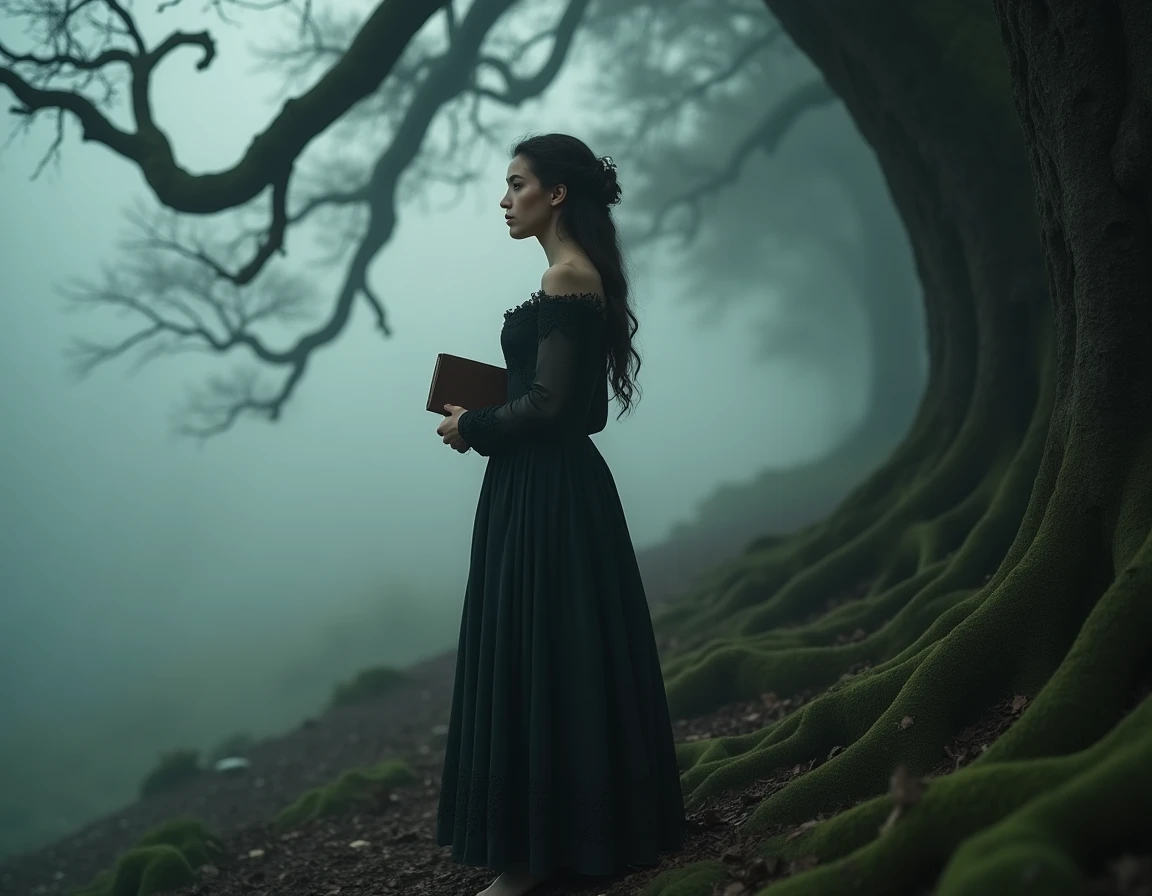
The figure of the devil’s daughter traverses literature, cinema, and European folklore in very different forms. What distinguishes a film adaptation from a novel rooted in social realism, and how does the same archetype carry opposing meanings depending on the medium? This is what the confrontation between recent works mobilizing this motif allows us to observe.
Edinburgh Folklore and Urban Witchcraft: The Forgotten Soil of the Myth
Competitors addressing the devil’s daughter focus on plot summaries or the technical details of a film. None delve into the historical substrate that fuels this myth. Jenni Fagan’s novel, published under the title The Devil’s Daughter, sets its action in a fictional building on the Royal Mile in Edinburgh, but this choice is far from arbitrary.
The alleys and squalid buildings that lined the Royal Mile in the 19th century nourished a dense folklore, filled with pacts with the devil and family curses. Scottish popular tales attributed hauntings related to the misery of their occupants to the oldest buildings. Fagan exploits this memory by making her building a character in its own right, traversed by a century of dramas.
To delve deeper into the origin of the devil’s daughter on Familles Connectées, one must return to this layer of local folklore that contemporary fiction reactivates. Fagan’s novel does not merely recycle an archetype: it roots it in a real geography where witchcraft historically served to designate the marginalized.

Novel, Film, TV Movie: Comparative Table of Works Surrounding the Devil’s Daughter
Several works share an identical or very similar title, which creates frequent confusion. The table below helps to distinguish the approaches.
| Work | Format | Year | Main Angle | Genre |
|---|---|---|---|---|
| The Devil’s Daughter (Jenni Fagan) | Novel | 2021 (Original) / French translation | Social critique, Scottish folklore, intergenerational transmission | Magical realism |
| The Devil’s Daughter (film) | Film | 2017 | School institution, suspense | Thriller / horror |
| The Devil’s Daughter | TV Movie | 1973 | Possession, demonic pact | Classic horror |
The genres range from psychological thriller to magical realism. The 1973 TV movie fits into the wave of American satanic horror, starring Shelley Winters. The 2017 film transposes the motif into a contemporary school setting. Fagan’s novel, on the other hand, constructs a narrative spanning an entire century.
Social Critique Behind the Demonic Figure: What Jenni Fagan Really Tells
The devil’s daughter in Fagan’s work is not a supernatural creature in the classic sense. She arrives in Edinburgh in 1910, rows on a coffin, and wears a bonnet that hides two small horns. Her father sold her to the owner of a building to bear the child of his sterile wife. The initial pact triggers a curse that unfolds over a hundred years.
Each decade of the 20th century is narrated through a different resident of the building: a taxidermist obsessed with creating a mermaid skeleton, a sixty-year-old medium, the leader of a gang at war with the triads, an unemployed miner allergic to light, a spy fascinated by aviators.
Gentrification and Institutional Violence
Several English-speaking critics note that Fagan uses the figure of the devil’s daughter to address very concrete realities:
- The gentrification of Edinburgh, which gradually erases the memory of the working-class neighborhoods where the novel takes place
- Domestic and institutional violence against women, passed down from one generation to the next as a form of secular curse
- The marginalization of precarious populations, pushed out of the city center over the decades
The “devil’s daughter” functions here as a symbol of class resistance, not as a figure of horror. The characters that Fagan calls “outsiders” are not passive victims: they occupy the center of the narrative and of history.

Satanic Horror in Cinema and Social Realism in Literature: Two Opposing Uses of the Same Archetype
The 1973 TV movie and Fagan’s novel share a title, but their narrative mechanisms diverge on all fronts. In the TV movie, the devil’s daughter is an external threat that intrudes into a home. Fear arises from the intrusion. In Fagan’s work, the threat is already present: it resides in the social structure itself, in poverty, in the power dynamics between landlords and tenants.
The 2017 film is closer to a school thriller. Rose and Kat, held in a prestigious institution, operate in a closed setting reminiscent of the gothic boarding schools of European horror cinema. The tension relies on isolation and secrecy, not on social critique.
In contrast, the novel overlays genres. Fagan alternates major historical events and minute details of daily life, giving the narrative a texture that the cinematic format compresses out of necessity. The transition from one decade to another, floor by floor, creates an architectural structure that cinema does not replicate.
Why the Devil’s Daughter Remains an Active Literary Motif
The motif of devilish descent does not exhaust itself because it lends itself to renewed readings. In the 1970s, it served post-Rosemary’s Baby horror cinema. In the 2020s, Fagan subverts it to produce a social novel that borrows from the fantastic without fully yielding to it.
- Scottish folklore provides a geographical and historical anchoring that American adaptations do not exploit
- The intergenerational transmission of trauma replaces possession as a narrative device
- The figure of the devil becomes a metaphor for capitalism and exploitation, not a supernatural entity to be fought
This shift from horror to social critique carried by a fantastic imagination explains why the motif continues to produce very different works under the same title. The next adaptation or rewriting of the devil’s daughter will reflect the anxieties of its time, just as each of the previous ones has done before it.